
All Poets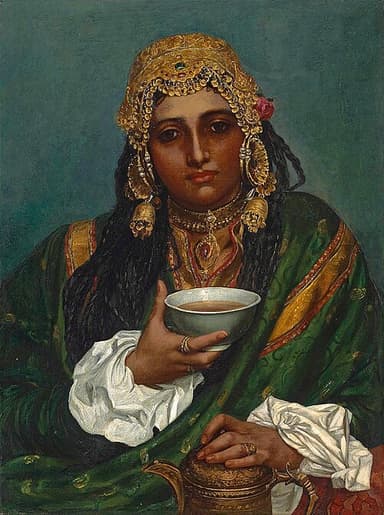
16th Century (c. 1554–1609) — Romanticism, Separation (Hijr) & Earthly Love
حَبہٕ خاتوٗن
Habba Khatoon
(Zoon)ژٕ کئمؠ سٲنی مٲوِتھ، وۄلۆ مؠانی گاشہِ روٗلہِ
"Who has lured you away from me? Come back, O light of my eyes."
The Legend
Sixteenth-century Kashmir, under the twilight of the Chak dynasty, was a realm caught between intense cultural efflorescence and the encroaching shadow of Mughal annexation. It was an era that required a voice capable of articulating both the beauty of its landscape and the fragility of its sovereignty. Out of this historical crucible emerged Habba Khatoon (حَبہٕ خاتوٗن). She was not merely a romanticized queen or a tragic figure of folklore, but a foundational literary architect who pulled Kashmiri poetry down from the esoteric heights of mysticism into the intimate, aching reality of the human heart. As the definitive voice of feminine interiority in Kashmiri literature, she transformed the vernacular into a vessel for profound personal feeling.
Born as Zoon (زوٗن)—meaning the Moon—in the saffron-yielding village of Chandhara (چندہار), her early life was deeply tethered to the agrarian and sensory rhythms of the Valley. While historical records are sparse, oral tradition and literary scholarship suggest she possessed a rare intellect, receiving early exposure to Persian literature. However, her true genius lay in her native tongue. Married young to an illiterate peasant, Zoon found herself in a deeply alienating domestic sphere. It was within this suffocating environment that her poetic voice first awakened. She began to compose verses that interrogated her confinement, giving unprecedented linguistic shape to a woman’s desire for intellectual parity and emotional resonance.
Her life's trajectory shifted dramatically through her encounter with Yousuf Shah Chak (یوٗسُف شاہ چَک), a nobleman who would later ascend the throne of Kashmir. While popular lore often mythologizes their union as a pure fairy tale, historically, it was a complex intersection of art, class, and power. As his wife and confidante, Habba Khatoon entered the royal court, where she wielded significant cultural influence. During this period, she revolutionized Kashmiri literature by popularizing the *vatsun* (وَچُھن)—a rhythmic, deeply musical poetic form typically consisting of three-line stanzas followed by a recurring refrain. This structure perfectly accommodated the natural cadence of the Kashmiri language, allowing for a seamless fusion of poetry and melody, and firmly establishing secular, earthly love as a legitimate subject for high art.
The geopolitical tragedy of 1586 irreversibly fractured her world. When Mughal Emperor Akbar annexed Kashmir, Yousuf Shah Chak was deceitfully imprisoned and exiled to Bihar, never to return. This loss catalyzed Habba Khatoon’s most profound and enduring work. Her poetry transformed from a celebration of aesthetic beauty into a vast, haunting landscape of mourning. She became the living embodiment of *yi chhu firāq hund dard* (یہِ چھُ فراق ہُند درد)—the agonizing pain of separation. Yet, her grief was never a silent or passive suffering; it was a highly articulated, dignified confrontation with loss. She mourned not only the exile of her beloved, but the death of Kashmir’s political autonomy.
Habba Khatoon’s linguistic genius lay in her stark, lyrical vulnerability. Stripping away complex Persian conceits, she anchored her metaphors in the immediate Kashmiri landscape—the blossoming valleys, the rushing mountain streams, and the fading autumn light. In verses such as *Tse kamiu soni myani barhem rosh* (ژٕ کٔمی سۄنہِ میٲنی بَرہم روش)—"Who has poisoned your ears against me, my love?"—she captures a piercing emotional immediacy that requires no scholarly mediation to be felt. Her poetry is inherently musical; she is widely credited with introducing the *Rast-e-Kashmiri* raga, inextricably weaving her verse into the classical Sufiyana traditions of the Valley.
In the aftermath of her husband's exile, tradition holds that Habba Khatoon wandered the Valley, singing her sorrow to the mountains and rivers. She transcended her personal tragedy to become a symbol of Kashmir's own dispossession and enduring dignity. Her legacy as a foundational female poet rests on her audacious, uncompromising assertion of the self in a male-dominated world. Today, she remains the eternal matriarch of Kashmiri lyricism. Her voice transcends the boundaries of history to anchor the emotional and cultural consciousness of Kashmir—an unyielding, immortal testament to love, memory, and the quiet defiance of survival.
Philosophy
Habba Khatoon redefined Kashmiri poetics by asserting the profound dignity of feminine interiority and earthly vulnerability. She stripped away esoteric mysticism to confront the raw, lived reality of love and separation, transforming the agonizing pain of loss—firāq hund dard (فراق ہُند درد)—into an uncompromising, lyrical articulation of the self. Her enduring legacy proves that true resilience is often found not in transcendent detachment, but in the fearless, vocal expression of a wounded yet sovereign human heart.