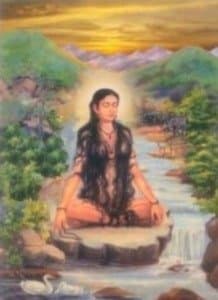
The Legend
Fourteenth-century Kashmir was a landscape poised at the threshold of a profound epistemic shift. As the classical frameworks of Trika Shaivism encountered the arriving currents of Central Asian Sufism, the Valley required a voice to translate this philosophical confluence into a lived vernacular. That voice belonged to Lalleshwari, universally revered as Lal Ded (لالہٕ دؠد). Far more than a mystic wandering the saffron fields, she was the primal architect of Kashmiri literary expression. Her utterance did not merely reflect the shifting spiritual climate of her era; it actively forged the syncretic conscience of Kashmir, distilling esoteric theology into the raw, accessible rhythms of the mother tongue.
Historical certainties regarding her life are inextricably layered with enduring oral tradition. Born in the village of Sempora near Pampore, Lal Ded’s early existence was circumscribed by the rigid social expectations of a traditional Brahmin household. Legend dictates that her domestic life was marked by severe austerity, most notably the cruelty of a mother-in-law who purportedly concealed a stone beneath a thin layer of rice on her plate. Yet, rather than breaking her spirit, these worldly afflictions acted as the crucible for her spiritual awakening. She abandoned the domestic sphere—not in defeat, but in a radical act of renunciation. Shedding both social convention and material attachment, she embarked on an ascetic wandering, transforming personal suffering into a vast, uncontained search for absolute truth.
At the core of her spiritual worldview was Kashmiri Shaivism, an intense, non-dualistic philosophy that sought union with the divine not through distant heavens, but through the realization of the self. Lal Ded vehemently rejected the hollow performativity of orthodox ritualism. For her, the divine was not confined to stone idols, priestly mediation, or temple precincts; it was an omnipresent reality requiring inward excavation. She articulated that true liberation demanded looking inward to discover the self, a pursuit captured in the profound realization that andar chhu panun raaz (اندر چھُ پَنُن راز)—the ultimate secret lies within. Her mysticism was inherently democratic, demanding that the seeker strip away the ego to recognize the fundamental unity of all existence.
Her philosophy was immortalized through the Vakh (واکھ), derived from the Sanskrit Vak (spoken word). These four-line, aphoristic stanzas constitute the genesis of recorded Kashmiri literature. Through the Vakh, Lal Ded bypassed the exclusionary grip of Sanskrit scholarship, bringing the highest metaphysical inquiries directly to the peasant, the artisan, and the outcast. Her poetic language is striking in its economy and elemental power, utilizing metaphors drawn from everyday Kashmiri life—the weaver’s loom, the potter’s wheel, the frozen lake—to explain the complexities of consciousness, suffering, and liberation.
Her verses resonate with a fierce intellectual independence. In one of her most celebrated Vakhs, she challenges the sectarian divides that were beginning to formalize in her era: Shiv chhu thali thali rozan, Mo zan Hindu ta Musalman (شِو چھُ تھلہِ تھلہِ روزان، مو زان ہِندو تہٕ مُسلمان)—"Shiva abides in all that is; do not distinguish between Hindu and Muslim." She urges the seeker: Truk ay chhukh pan panun parzanav (تُرُک اَے چھُکھ پَن پَنُن پَرزناو)—"If you are wise, recognize your true self." This inward turn was not a retreat from the world, but a radical reorientation of how one engaged with it, asserting that knowing oneself was the only authentic path to knowing the Divine.
The resonance of Lal Ded extends far beyond the boundaries of her own lifetime. She serves as the vital spiritual bridge between the Valley's indigenous Shaivite traditions and the emerging Islamic Rishi order. Her legendary encounter with the infant Sheikh Noor-ud-Din Wali (Nund Rishi)—whom she is said to have nursed—symbolizes this unbroken continuity of Kashmiri spiritual thought. To the Kashmiri Pandits, she is Lalleshwari, the supreme yogini; to the Kashmiri Muslims, she is Lal Ded, the revered mystic grandmother. She belongs equally to both, yet fully to neither, transcending theological boundaries to become the shared, beating heart of the region's syncretic ethos.
Lal Ded cannot be confined to the realm of mere folklore or ascetic devotion. She remains the foundational matriarch of Kashmiri linguistic and cultural identity. As long as her Vakhs are recited in the Valley—whether in moments of solitary grief, scholarly debate, or collective spiritual seeking—her voice endures. She stands as a timeless monument to inward freedom, reminding generations that the ultimate sanctuary of truth is not built of stone, but forged within the awakened human soul.
Lal Ded redefined spiritual pursuit as a fierce, solitary excavation of human consciousness, entirely stripping away the performative rituals of orthodox religion. Rooted in non-dualistic Shaivism, she taught that absolute liberation is not granted by external deities, but realized through an uncompromising inward gaze—*andar chhu panun raaz* (اندر چھُ پَنُن راز)—where knowing the true self is identical to knowing the divine. Her worldview remains a timeless testament that ultimate truth is found not in temples or doctrines, but within the sovereign, awakened soul.